Vegetable Garden Project – Phase II – Philippines



The GFF HELPS Philippines is delighted with the successful result of the Solar Project Phase 1 in the Village of Mercedes in the Town on Madalag last December 2020. Upon hearing the beneficiaries’ meaningful testimonies and seeing how the Solar Lights have been changing their lives, we pushed through the second phase in the next prospect village, the Galicia, without any hesitation.

The “English for Village” concept was proposed by Dr. P.A. Kiriwandeniya, chairman of SANASA University Campus, Kegalle, with the intention of sharing English communication knowledge from undergraduate students to the rural community as a voluntary service. This was supported by the GFF Sri Lanka team, who saw it as a valuable opportunity for village children to learn English skills while also helping to develop the leadership skills of undergraduate students.


Image: Pavithra Gunasekara (right) and first Sri Lanka GFF Representative, Tharaka Munidasa (left) standing at the entrance to SANASA Campus.
Hi there, my name is Pavithra Gunasekara. I am a recent graduate from SANASA Campus, Kegalle, Sri Lanka, having completed a Bachelor of Science in Regional Science and Planning. My degree programme was based on community development where I got the opportunity to engage and work with a SANASA Primary Society (local cooperative community groups). With their collaboration, I developed an “Integrated Rural Development Plan” for four years under five pillars: community empowerment, uplifting the low-income families, developing infrastructure facilities, improving education & health and developing the local cooperative community groups. The second project was on encouraging small to medium entrepreneurs in Makola South area by aiding credit finance.
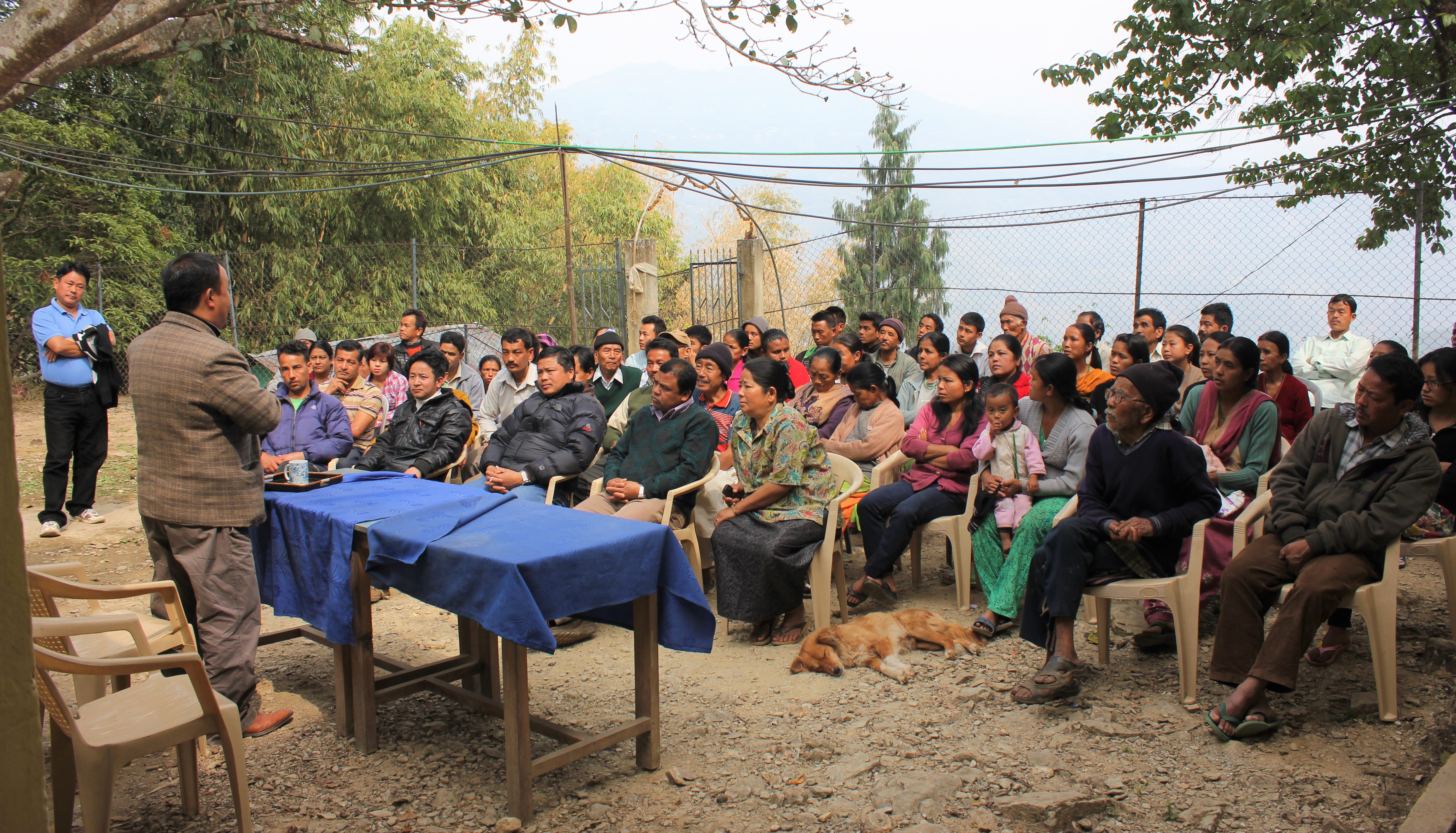
Saom Tshering Namchu of GFF India, facilitating a village meeting in Kalimpong, India
The Glenn Family Foundation supports charities, institutions and individuals around the globe in the upliftment of poor communities and alleviation of suffering. The philosophy of its founder is in offering a hand up, not a hand out, and in so building communities that are empowered, self-sustaining and proud.
The Foundation uplifts communities through its “Village Development Model” by providing them with sustainable access to their most basic needs. This includes but is not limited to access to clean water, access to solar power, improved sanitation to reduce incidence of disease and improved living conditions to foster a sense of pride.We also recruit international and local volunteers to enrich these communities through education, health initiatives, skills sharing and technical expertise. Our volunteers are enmeshed in these communities for a six month period to ensure they have a meaningful impact. The National Standards for Volunteer Involvement (2015) attest to the valuable contribution that volunteers make toward the attainment of an organisations goals by extending the capacity of the organisation through their time, skills, expertise and points of view. GFF works to embody these standards in all its engagements with volunteers and considers volunteers as a vital part of its strategy.

Image: Tharaka Munidasa, front centre, and GFF India Saom Namchu, back centre, pictured here with children from the rural community who are involved with a SANASA Campus programme.
An introduction to Tharaka
Hi there my name is Tharaka! I am a recent graduate from the University of Auckland having completed a Bachelor of Mechanical Engineering with First Class Honours. I was born in Sri Lanka but moved to New Zealand when I was 6 months old. Growing up with two different cultures, I was determined to fuel my curiosity to develop my global mindset. I gained secondary schooling experience in Hiroshima, Japan through my Asia Student Exchange Scholarship, a semester abroad at Pennsylvania State University, USA through the 360° Auckland Abroad Exchange Travel Award and finally, professional experience where I completed an internship abroad in Shenzhen, China through the Prime Minister’s Scholarship for Asia.
Having reflected on the wonderful opportunities I have had abroad, I set a goal to give back to communities in Sri Lanka before engaging in my career. I connected with the Glenn Family Foundation (GFF) through the University of Auckland Business School, where I proposed the idea to expand GFF’s global reach by coming to Sri Lanka to facilitate a partnership with a local NGO and establishing a new location for the HELPS programme. I believe I can make a greater impact on my hometown if I can create the opportunity for volunteers to get involved for years to come! My current volunteer involvement involves teaching English communication skills to first-year students at SANASA Campus and looking to transfer these skills towards children in the village. Furthermore, I am consulting on an IT Development Programme to build IT skills for students and the community.
Equipped with the valuable experience and feedback from our first GFF Representatives and the important lessons learned, we enter 2019 ready to scale up our operations and deepen our work.
July 2018 marked the deployment of our first group of “GFF Representatives” of the GFF HELPS programme. We received applications from over 50 candidates and selected 8 – the majority from the University of Auckland, where our Founder has strong ties and a long history as a major donor. These 8 Representatives attended an in-person or online briefing before being deployed in pairs to rural communities in need, which were to be their homes for the next six months. They showed tremendous courage, maturity and cultural sensitivity, forming good relationships with local stakeholders and initiating projects ranging from Digital Learning and Mobile Libraries, to Solar, Football Coaching, Recycling and Hygiene workshops. We learned a great deal about the rural contexts we were in and their unique challenges and strengths. We also learned the importance of clear expectations between ourselves and our partners, which will help to strengthen our work going forward. These are the highlights from two of our GFF Representatives who have recently returned home, Sophie and Joe, followed by more detail about what we did in each location.
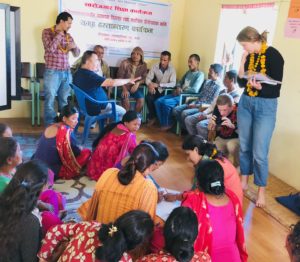
Sophie administering a questionnaire to the women’s group in Kavre
“Spending the night in Kavre Village was the highlight of my experience in Nepal, it was amazing to see how the village operates and the community works. The way in which the people live and to hear their stories and share a meal with them. It is always a humbling experience to sit among people who have the bare minimum of necessities, who can smile and laugh with you and are willing to share what little they have with you. It was also enlightening for me to hear the big difference a small amount of learning can make to one persons life. Basic literacy is something that can be taken for granted when you live in countries like New Zealand, but the things you are limited in doing by being unable to recognise numbers or count are innumerable and take your independence away. Yet through all of their struggles, all of the difficulties, these women smile and laugh.” – Sophie Jones-Williams, GFF Representative 2018, India and Nepal.
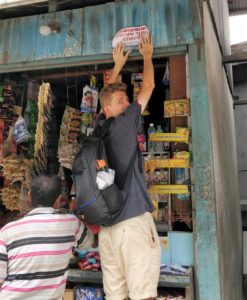
Joe officially declaring an area a Child Labour-Free Zone in Kalimpong, India
“I learnt to appreciate that on the whole people are generally good and want to do what they can to help others. Almost every person I met during our stay was incredibly welcoming and couldn’t do enough to help us be comfortable in their country. Whenever I did something to help someone such as running a football training session, they couldn’t be more appreciative to me for giving up my time to help them. It can be easy to forget that most people are good people that want to make the best of themselves and others around them, no matter what their background may be.” – Joe Fisher – GFF Representative 2018, India and Nepal.
We worked alongside a local project, the Yolanda Aklan Reconstruction Programme, who facilitated our introduction to local schools and community leaders. We visited local schools and developed good relationships with the teachers, principals and department heads and put forward our ideas for the schools. We ran a pilot of our Digital Learning project, where we use inexpensive tablets as learning aids to supplement schools with few resources. We learned some valuable lessons for how to adapt this project in different contexts.
We piloted our Village Solar Project; developing a model for providing solar panels in areas difficult to access. These households do not have access to the grid and rely on harmful kerosene for lighting, which causes fires and respiratory illnesses. Our GFF Representatives ran Reading Workshops in four schools and started a Mobile Library to enhance language development.
In Vietnam we ventured North to identify a suitable rural community to work with and found a severe lack of sanitation infrastructure. We built 10 toilets and two washrooms for a new school that will service 500 children from the surrounding villages. In the South we partnered with a local NGO and sponsored 10 children through their schooling. We also identified a rural community and are building our connections there for future work.
In India we partnered with one of our grant recipients, the Bal Suraksha Abhiyan Trust, and worked alongside them in their child labour programmes and started a football coaching course which continues to flourish in our absence. We faced some visa challenges and so decided to move our Representatives to Nepal, where we had identified a very promising women’s education and empowerment programme, run by a local NGO, Child Development Society. We visited their women’s groups and found good opportunities for partnership. You can read Sophie’s research report and see Joe’s documentary about this work here. We also introduced recycling to a local school and ran a football club.
This first round of our HELPS programme was illuminating; we were able to test out our internal processes and a lot of project ideas to see which gained traction. This has strengthened our programme plans and operations, enabling us to enter the field in 2019 stronger, more focused on our objectives and able to deliver larger impact. We are under no illusion that there is still a lot of learning to do, and we are looking forward to 2019 and seeing how this programme develops.
GFF Team.


